
Have you ever noticed the things around you and throughout the web are being personally tailored based on your online activities? Depending on what you search the most, the links you open, your location, the device being used and even the internet connection you’re connected to affects the way the algorithms on some of your favourite websites (Including Google, Facebook, YouTube, etc.) present results.
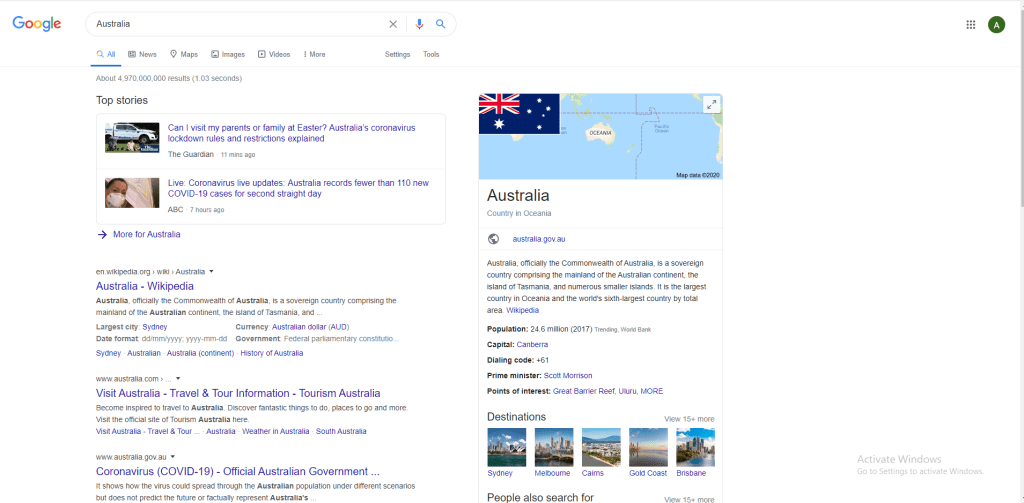
The term ‘Filter Bubble’ (A quick definition) is used to describe the effects of the algorithms on said websites and the internet in general and refers to the bubble of information which the algorithm dictates as it filters out information and opinions which don’t conform with a user’s online behaviours or beliefs. To demonstrate this, I performed a quick Google search on my personal Desktop and my mum’s work Laptop.
My Search Results:
Mum’s Search Results
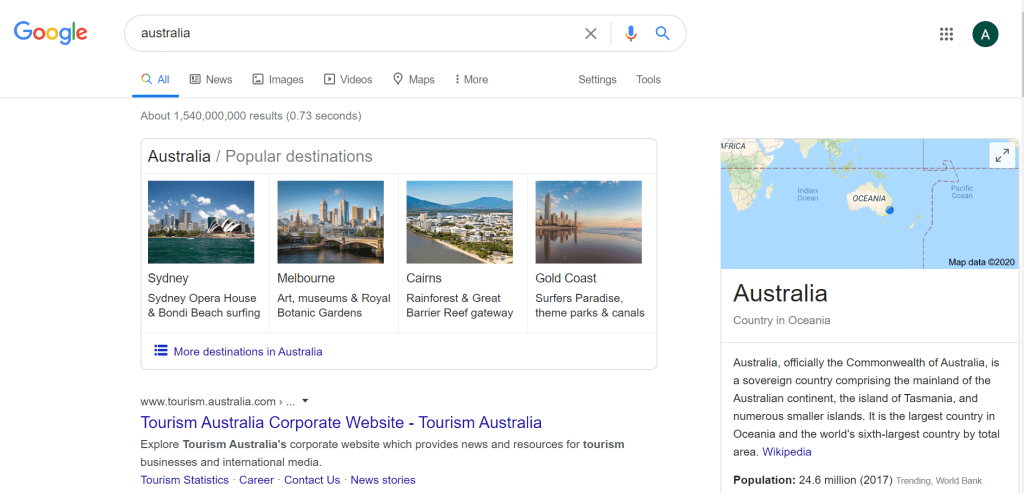
We both searched for the term “Australia” and received completely different results, my results contained mostly COVID-19 related articles and websites, while my mum’s search returned only tourism-related websites and destinations. This is one of many prime examples of the work a Filter Bubble can accomplish and to reiterate how our personal Filter Bubbles are formed, this article by Mike Mcevoy explains what key factors Googles search algorithm uses to decide what we do or don’t see.
During this TED talk, Eli Pariser address various reason as to why Filter Bubbles are a concern for our society and also suggests what algorithms should do in order to address these problems by allowing Filter Bubbles to let a balance of information in.
The problems and concerns raised during the TED talk vary from the user not being able to choose what gets inside their tailored universe of information, to also not being able to see what types of information the Filter Bubble actually ends up filtering out. For example, going back to the differences between my mum and I’s Google search results, her Filter Bubble actually decided to filter out some of the most up to date and important information based on the COVID-19 pandemic within Australia, leaving her without potentially relevant and valid information which she may never know was denied to her.
Solutions to the flaws within these algorithms and the Filter Bubbles they create are to show a balance of information and results instead of entirely filtering out sections of so-called ‘unwanted information’, which is entirely being decided upon by various online algorithms. Once again, relating back to the search results my mum received in the earlier example, instead of entirely filtering out everything other than tourist attractions/destinations, the algorithm should instead show a balance of information and include at least a couple websites or articles which are currently important and relevant based on the search terms (In this case, news relating to Australia).
Steps involved in popping this Filter Bubble can be found here, but some of the most common and simple methods anyone can use are as follows:
- Clearing browser history
- Clearing browser cookies
- Disabling cookies
- Using Incognito features or browsers which don’t track your activities
 Anthony's Blog