Be yourself; Everyone else is already taken.
— Oscar Wilde.
This is the first post on my new blog. I’m just getting this new blog going, so stay tuned for more. Subscribe below to get notified when I post new updates.
Be yourself; Everyone else is already taken.
— Oscar Wilde.
This is the first post on my new blog. I’m just getting this new blog going, so stay tuned for more. Subscribe below to get notified when I post new updates.
Early Weeks of LLWW
Have you ever been told you have to complete a task but not see the point or value in it? This was definitely my case when I was enrolling in my units for the Autumn 2020 Session. After coming across Living Learning and Working on the Web and finding it to be an online-only unit, my expectations dropped significantly. “How would this unit benefit me?” and “How am I able to ask questions about learning material?” were some of the first questions that came to mind. Also being me (Anthony, by the way), a current undergraduate student completing a bachelor’s degree in Cyber Security and Behaviour at Western Sydney University, it was required that this unit be completed in order to graduate after 3 full years of study.
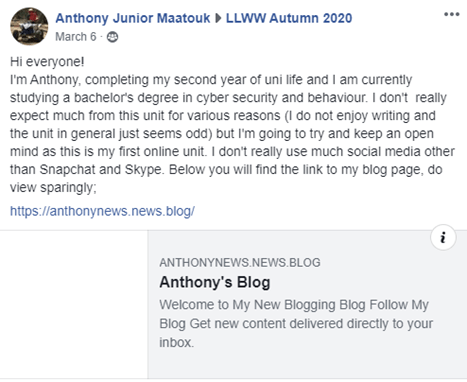
I remember telling myself that this unit was going to be a complete waste of time and an easy way to bludge without the need to apply any actual effort (Demonstrated by my first post in the LLWW Facebook group), but this opinion was to change in the next few coming weeks as I soon began to realize how and what this unit genuinely had to offer. The unit was able to help demonstrate a range of things, some of which consisted of:
– How somebody could work professionally online using various social media platforms and websites
– How a group of people are able to successfully interact and work together in an online working environment
– The importance of various topics which relate to people’s everyday lives and how they can affect everyone (Sometimes without them even knowing)
Delving Deeper
One of the first things that struck out when I was first reading material about the unit was its required use of Facebook. It was to be our primary contact method when communicating which other students and even our teacher’s, which was weird considering how every other unit was on campus with the main communication methods being face-to-face. Of course, my original opinion was fast to change once we began working throughout the semester, I found it much more convenient that class was to be held when I wanted, without having to go into campus and not to forget that questions could be simply asked with a few keystrokes at any time during any day. The unit furthered this by demonstrating how anybody could create a professional online working environment where you would be able to communicate your voices and opinions while also allowing others to view, interpret and respond via comments and even emailing’s. This was achieved through the use of a preferred blogging site, wordpress.com in my case (Visit here), where I was able to voice my opinion on topics of choice. The unit helped develop our writing methods and demonstrated various ways different things could be done. For example, we learnt to make more engaging writing by incorporating external sites and recourses used, directly into our text rather than creating a reference list and using in-text citations (Demonstrated here and here). We were also introduced to the idea of ‘feed-forward’ which involved submitting work earlier than required, allowing fellow students to read and comment in-order to further our writing to help improve our first copies. The idea of feed-forward is further explained here, which addresses its benefits over traditional feedback methods and touches reasons normal feedback is not so useful in comparison to feedforward.
Secondly, before completing this unit the tasks of group assignments and working with other students seemed daunting. It was always easy to worry if the other students in your group were keeping up with their section of work and in the end finding out once it would be too late. This was partly reasoned by only being able to have strong contact with each other once a week, during face-to-face time in tutorials, something this unit didn’t have. This forced group members to find alternate methods of communication such as messenger or discord and enabled us to work at our own pace and update each other live as we worked through the assignment. This also led to students developing new skills with different types of applications such as Google Doc’s (Here you can view our group campaign report) and Photoshop, therefore increasing our knowledge while even helping with future employability (Here are some traits which employers look for, E.g. Teamwork and ability with different suite’s such as Adobe or Microsoft Office).
Finally, before undertaking this unit I was uninterested in many topics circulating the web and even on the news, I just never seen the reason to pay it any attention as I believed most of it didn’t really concern me. LLWW also managed to change this outlook of mine and further develop my ability to interpret, understand and engage in such contents due to the weekly blog post topics which were given to us. Each one seemed to highlight something new while keeping things fresh and allowing me to gain insight into many challenging factors the world currently faces as we develop into a more digitalized society. Examples of such topics can be Surveillance and the privacy paradox or Information and Knowledge with filter bubbles deciding upon what we see while being online without our knowledge or consent (More on this topic here).
To Summarise
To quickly concluding my experiences, I would say I entered this unit without expecting anything in return, but to my surprise, it ended up providing me with a lot more than most of my other units. Living Learning and Working on the Web helped develop my mindset and increased my knowledge in many various aspects of life and in turn helped increase my employability skills while also demonstrating the importance of keeping up with current world challenges. This unit was also able to help me construct a professional online profile and working environment while also developing my communication and writing skills among many others.

Have you ever noticed the things around you and throughout the web are being personally tailored based on your online activities? Depending on what you search the most, the links you open, your location, the device being used and even the internet connection you’re connected to affects the way the algorithms on some of your favourite websites (Including Google, Facebook, YouTube, etc.) present results.
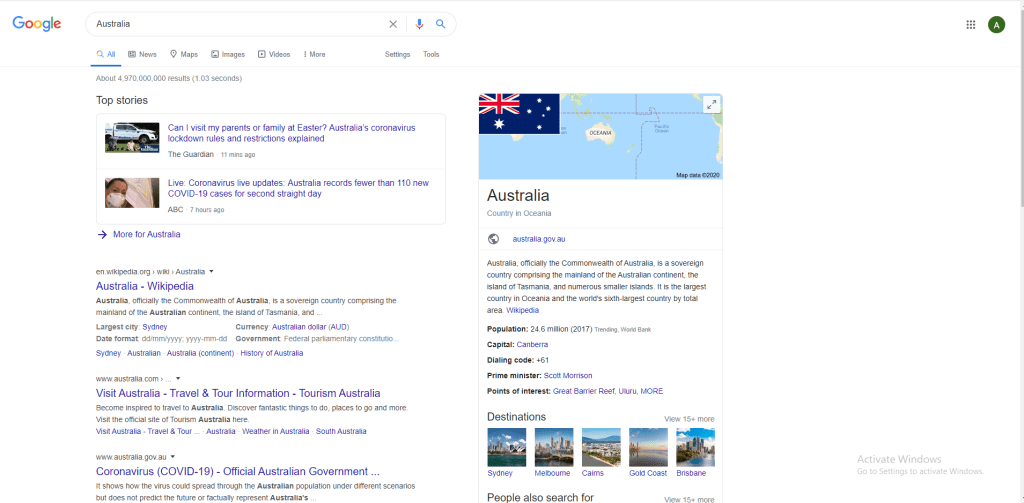
The term ‘Filter Bubble’ (A quick definition) is used to describe the effects of the algorithms on said websites and the internet in general and refers to the bubble of information which the algorithm dictates as it filters out information and opinions which don’t conform with a user’s online behaviours or beliefs. To demonstrate this, I performed a quick Google search on my personal Desktop and my mum’s work Laptop.
My Search Results:
Mum’s Search Results
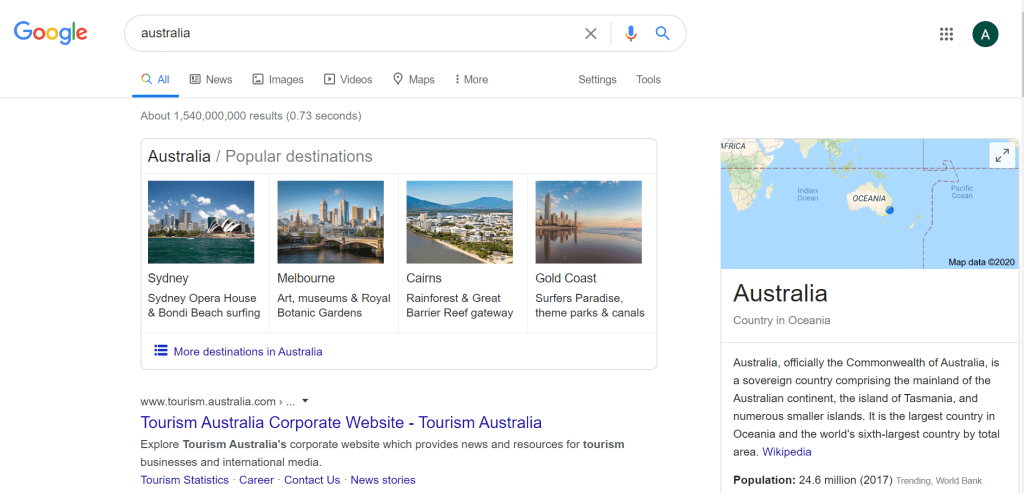
We both searched for the term “Australia” and received completely different results, my results contained mostly COVID-19 related articles and websites, while my mum’s search returned only tourism-related websites and destinations. This is one of many prime examples of the work a Filter Bubble can accomplish and to reiterate how our personal Filter Bubbles are formed, this article by Mike Mcevoy explains what key factors Googles search algorithm uses to decide what we do or don’t see.
During this TED talk, Eli Pariser address various reason as to why Filter Bubbles are a concern for our society and also suggests what algorithms should do in order to address these problems by allowing Filter Bubbles to let a balance of information in.
The problems and concerns raised during the TED talk vary from the user not being able to choose what gets inside their tailored universe of information, to also not being able to see what types of information the Filter Bubble actually ends up filtering out. For example, going back to the differences between my mum and I’s Google search results, her Filter Bubble actually decided to filter out some of the most up to date and important information based on the COVID-19 pandemic within Australia, leaving her without potentially relevant and valid information which she may never know was denied to her.
Solutions to the flaws within these algorithms and the Filter Bubbles they create are to show a balance of information and results instead of entirely filtering out sections of so-called ‘unwanted information’, which is entirely being decided upon by various online algorithms. Once again, relating back to the search results my mum received in the earlier example, instead of entirely filtering out everything other than tourist attractions/destinations, the algorithm should instead show a balance of information and include at least a couple websites or articles which are currently important and relevant based on the search terms (In this case, news relating to Australia).
Steps involved in popping this Filter Bubble can be found here, but some of the most common and simple methods anyone can use are as follows:
Growing up being the first child in my family of five (Including my parents), I never really had access to any digital technology outside of a microwave and TV. I was given my first mobile phone around year 5 of Primary School and only used it for making phone calls to a few close friends or my parents. During my final year of Primary School, I began playing some of my first mobile games (Fruit Ninja and Ninja Jump to name a few) to help pass time and compete with my friends, that was until I was introduced to the world of PC gaming once leaving for High School.
Originally the reason I began to play was because I thought it a way for me to keep in touch with many of my close friends after leaving Primary School, but I soon realised it was something I was really beginning to enjoy. After each day of school, I’d end up in the same place, playing the same game, with all the same people and I’d soon find myself buying a $15 plastic headset sold in a Two Dollar Store at the local shopping village just so I could talk with my mates through Skype each and every time we played. My dad, like many others, hated me playing so much and so often, later imposed a restriction which allowed me to only play during weekends and holidays. Of course I followed these restrictions but only when he was home, else you’d know where to find me, holed up and having a blast with my mates because my mum didn’t really see the problem in me playing.
In the years to come, I made new friends who also shared my fondness for PC gaming and for the next few years, without fail, you’d find us night after night enjoying ourselves as we all gamed to our heart’s content.
During my 10th year of schooling, I was finally able to upgrade computers and leave behind the stone age machine that could barely be passed as technology as it began to struggle to run even the most simplest of games and Windows Applications. I didn’t get anything mind-blowing, but considering the changeover from the old contraption, I was able to enjoy gaming on an entirely different level.
My final years of High School were a blur with nothing overly interesting happening but, without a doubt, even tho HSC was around the corner you’d find us all in the same place doing the same thing day in and day out. Till this day, I continue to follow the same schedule with the same people and looking back I don’t regret one day, being able to have something in common with millions of other people, gaming to me was an escape. It was something I could do with my friends at any time, we all enjoyed it and continue to do so.

 Anthony's Blog